

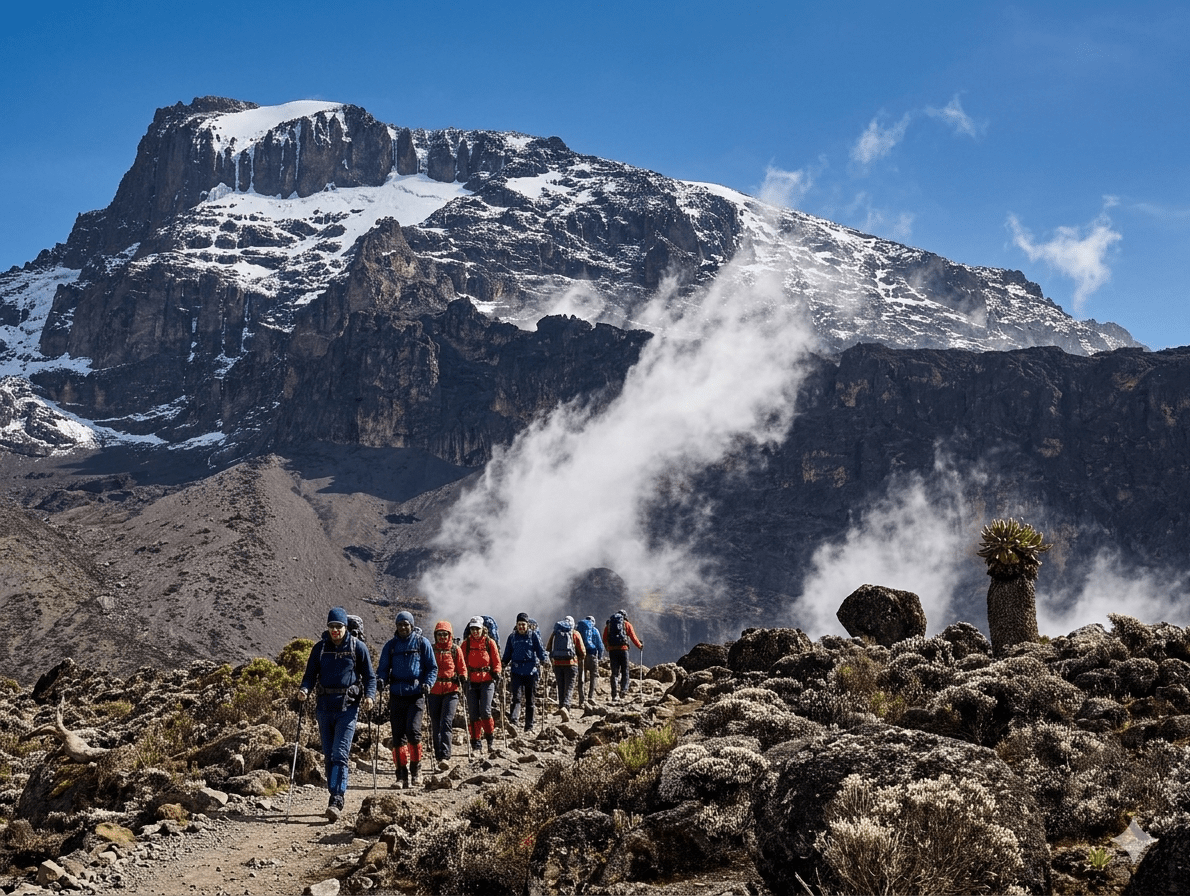
Climbing Kilimanjaro requires no mountaineering technique, but it is not a simple hike either. In less than a week, you go from tropical rainforest to alpine desert, then to the glaciers of the summit. In short, success comes down to two things: the right route and good acclimatisation.
Our guides set off from Moshi, at the foot of the mountain, and climb Kili all year round. This guide gathers what they tell every trekker before departure, starting with their two favourite routes: Machame and Marangu. Kilimanjaro National Park is also a UNESCO World Heritage Site.
Kilimanjaro trek: the essentials
To climb Kilimanjaro, choose a route of at least 6 to 7 days for good acclimatisation. Our favourites are the Machame route over 7 days and the Marangu route over 6 days. Go in the dry seasons (January to March or June to October), train for 2 to 3 months, and walk slowly, "pole pole". A licensed guide is mandatory, and the climb usually costs EUR 1,700 to 4,500 per person.
Kilimanjaro routes compared
Six main routes lead to the summit. They differ in length, scenery and above all in their acclimatisation profile, which is the factor that matters most for your chances of reaching the top.
| Route | Length | Difficulty | Acclimatisation | Best for |
|---|---|---|---|---|
| Machame Our pick | 6 to 7 days | Demanding | Good | The best balance of scenery, length and success |
| Marangu Our pick | 5 to 6 days | Moderate | Fair over 6 days | Hut accommodation, steady slope, shorter trip |
| Lemosho | 7 to 8 days | Moderate | Excellent | Those with time who want a quiet start |
| Rongai | 6 to 7 days | Moderate | Good | Avoiding crowds, climbing in the wetter months |
| Northern Circuit | 8 to 9 days | Moderate | The best | Maximising your chances, very quiet trails |
| Umbwe | 5 to 6 days | Very hard | Poor | Hikers experienced at altitude |
Which route suits you?
What the climb looks like, day by day
Whatever the route, the trek crosses the same main vegetation zones. Here is a typical 7 or 8-day climb.
- The rainforestDays 1 and 2, from 1,800 to 3,000 m
Departure from the park gate, under moss-covered trees. Humid heat and colobus monkeys along the trail.
- Moorland and giant groundselsDays 2 and 3, from 3,000 to 4,000 m
Then the forest gives way to giant heathers and the first open views of the summit.
- Alpine desert and acclimatisationDays 4 to 6, from 4,000 to 4,600 m
You climb high during the day and sleep lower down: this prepares your body for summit night.
- Summit nightDay 6 or 7, up to 5,895 m
Departure around midnight by headlamp, at the slow pace of the guides. Sunrise over the crater, then arrival at Uhuru Peak.
- The descentLast day, back to Moshi
Finally, a quick descent via the Mweka route, certificates and, for many, a well-deserved beer.
8 tips for a successful Kilimanjaro trek
Add an acclimatisation day
Machame over 7 days rather than 6, Marangu over 6 days rather than 5: this extra day clearly improves your chances of reaching the summit.
Walk "pole pole"
"Slowly" in Swahili: the word your guides will repeat most. Starting too fast is the number-one mistake.
Drink 3 to 4 litres a day
Hydration helps your body adapt to altitude, even when you are not thirsty.
Train for 2 to 3 months
Regular cardio and long hikes with elevation gain, carrying a pack and wearing your trekking boots.
Break in your boots
New boots are the most common cause of blisters, so walk in them for several weeks beforehand.
Use the 3-layer system
You go from 25°C in the forest to sub-zero temperatures at the summit: layer up rather than pack heavy.
Get insured up to 6,000 m
Check that your travel insurance covers high-altitude trekking and emergency evacuation, on top of the mandatory Tanzania travel insurance.
Listen to your guides
They monitor your condition every day. Report any symptom, even a mild one.
Acute mountain sickness: the signs to know
Above 3,000 m, many trekkers feel mild symptoms. They must be reported to the guide straight away:
- headache, nausea or loss of appetite;
- unusual fatigue, dizziness, difficulty sleeping;
- breathlessness at rest or confusion: in this case, descent is immediate.
Talk to your doctor before departure, especially about preventive medication, and check the advice of the CDC for Tanzania.
Essential gear
Clothing
- Thermal base layers
- Fleece and warm down jacket
- Waterproof jacket and trousers
- Hat, warm gloves, neck gaiter
Hiking
- Broken-in high trekking boots
- 30 to 40 L daypack
- Trekking poles
- Water bottles or a 3 L bladder
Night and summit
- Cold-weather sleeping bag
- Headlamp and batteries
- Glacier sunglasses
- SPF 50 sunscreen
No need to buy everything: sleeping bags and poles can be rented in Moshi. We send you the full list when you book.
How much does a Kilimanjaro trek cost?
The price includes park fees, set by Tanzania National Parks, which make up a large part of the budget, as well as guides, porters, cook, meals and camping equipment. Be wary of very cheap offers: they often come at the expense of safety and porters' working conditions. The Kilimanjaro Porters Assistance Project sets fair treatment standards for porters.
After the summit: safari and Zanzibar
Most of our trekkers extend their trip with a few days of safari in the northern parks, then the beach in Zanzibar to recover. Find all our ideas in the 10 best things to do in Tanzania, plan your safari with our Great Migration guide, and spend your first days in Moshi, at the foot of the mountain.
Useful official links
Trusted sources to prepare your climb.
Kilimanjaro trek: FAQ
Is Kilimanjaro hard to climb?
It requires no mountaineering skills, but the altitude makes it a real challenge. Good fitness, an acclimatisation day and a slow pace are enough for most healthy hikers.
How many days does it take to climb Kilimanjaro?
Between 5 and 9 days depending on the route. We recommend the Machame route over 7 days or the Marangu route over 6 days, to give your body time to acclimatise.
What is the best time to climb Kilimanjaro?
The dry seasons, from January to March and from June to October. However, the long rains in April and May make the trails slippery and block the views.
Can you climb Kilimanjaro without a guide?
No. The climb must be done with a licensed guide and a crew registered with Kilimanjaro National Park.
Which Kilimanjaro route has the best success rate?
The longer routes, such as the Northern Circuit and Lemosho, offer the best acclimatisation and therefore the best chances of reaching the summit.
Do I need the new Tanzania travel insurance to climb Kilimanjaro?
Yes. Since 1 October 2026, all foreign visitors entering Mainland Tanzania need the mandatory USD 44 inbound travel insurance. In addition, make sure your own travel insurance covers trekking up to 6,000 m.
