

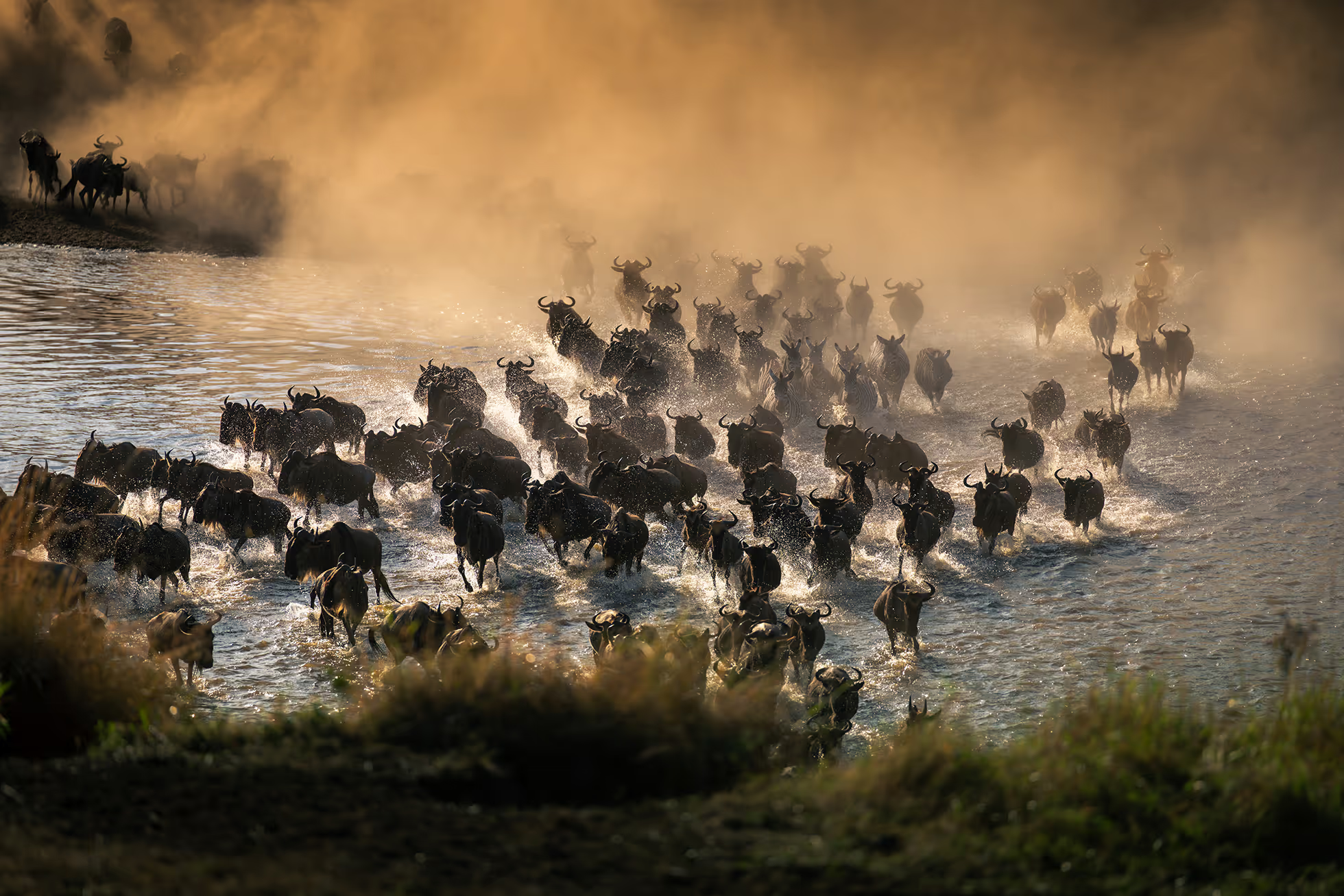
The Great Migration is not a one-off event but an endless journey. All year round, the herds circle the Serengeti-Mara ecosystem clockwise, in search of fresh grass. So there is no single best time to see the Great Migration: instead, there is a right place for each month.
The herds follow the rains, and their timing varies by a few weeks from one year to the next. That is why our guides, based in Moshi, follow their movements in real time to place your camp as close to the action as possible.
Great Migration safari: the essentials
The Great Migration can be seen in the Serengeti all year round, but in different areas: the south and Ndutu from December to March for calving, the centre in April and May, the Western Corridor in June and July, the north and the Mara River from July to October for the crossings, and the east in November. The two highlights are February and August to September.
The Great Migration calendar, month by month
- JanuarySouth, NdutuCalving begins
- FebruarySouth, NdutuCalving peak and predators
- MarchSouth, NdutuYoung calves, green grass
- AprilCentre, SeroneraLong rains, few visitors
- MayCentre and westRut, long columns
- JuneWest, GrumetiGrumeti River crossings
- JulyWest then northFirst Mara crossings
- AugustNorth, KogatendeMara River crossings
- SeptemberNorth, KogatendeMara River crossings
- OctoberNorth, Mara RiverLast crossings
- NovemberEast, LoboHeading back south
- DecemberSouth-east to NdutuHerds arrive
HighlightsGood timeRainy season, lower prices
December to March: the calving season in the south
The herds gather on the short-grass plains of the southern Serengeti and the Ndutu area. In February, thousands of wildebeest calves are born every day, over just a few weeks. As a result, lions, cheetahs and hyenas are everywhere: it is the best time for hunting scenes.
- Where
- Southern Serengeti, Ndutu
- What you see
- Calving, predators
- Recommended stay
- 2 to 3 nights
Our tip: This is our favourite time. Ndutu lies right next to the Ngorongoro Crater, so you can combine both without long drives.
April and May: moving north during the long rains
The herds leave the south and head to the centre and west of the park, sometimes in columns several kilometres long. It is also the rutting season. Tracks can be muddy and some camps close; however, the park is almost empty and prices drop.
- Where
- Centre (Seronera) and west
- What you see
- Long columns, rut
- Best for
- Flexible travellers, smaller budgets
June and July: the Western Corridor and the Grumeti River
The herds cross the Western Corridor and face their first obstacle: the Grumeti River and its crocodiles. These crossings are less famous than the Mara ones, but just as intense, with far fewer vehicles.
- Where
- Western Corridor, Grumeti
- What you see
- Crossings, crocodiles
- Recommended stay
- 2 nights
July to October: the Mara River crossings
This is the most famous image of the migration: thousands of wildebeest plunging into the Mara River, between strong currents and crocodiles. The herds move back and forth between the northern Serengeti and Kenya's Masai Mara, so a crossing can happen at any time of day.
- Where
- Northern Serengeti, Kogatende
- What you see
- Mara River crossings
- Recommended stay
- At least 3 nights
Our tip: On the Tanzanian side, there are far fewer vehicles than on the Kenyan side. Book 6 to 12 months ahead, because camps close to the river fill up fast.
November: heading back south
With the short rains, the herds move down through the east of the park, around Lobo, to return to the southern plains. A calm, green transition period, often with softer prices.
- Where
- Eastern Serengeti, Lobo
- What you see
- Herds on the move
- Best for
- Travellers avoiding crowds
Which month suits you?
6 tips for a successful migration safari
Choose a mobile camp
These tented camps move with the herds and put you close to the action.
Stay 3 nights in one place
The herds move every day, so the longer you stay, the better your chances of seeing a crossing.
Book early for high season
From July to September, the best camps are full 6 to 12 months ahead.
Consider an internal flight
The northern Serengeti is far from Arusha. A short flight saves you a long day on the tracks.
See it from the sky
A hot-air balloon flight over the herds, with our partner Miracle Experience, is unforgettable.
Accept the element of chance
Nature does not follow a calendar. Even without a crossing, the Serengeti always delivers exceptional sightings.
Sources and useful links
Official and specialist references on the Great Migration.
- UNESCOSerengeti National ParkThe World Heritage listing.
- UNESCONgorongoro Conservation AreaWhich includes the Ndutu area.
- ParksTanzania National Parks (TANAPA)The Serengeti's official authority.
- NgorongoroNgorongoro Conservation Area AuthorityThe official site of the crater.
- SpecialistAsilia: the Great MigrationThe cycle, numbers and areas.
- Our partnerMiracle ExperienceBalloon flights over the migration.
Great Migration: FAQ
What is the best month to see the Great Migration?
February for the calving season in the southern Serengeti, and August or September for the Mara River crossings. These are the two highlights of the cycle.
When can you see the Mara River crossings?
Usually from July to October, with a peak in August and September, in the northern Serengeti. The exact dates vary with the rains.
Is it better to see the migration in Tanzania or Kenya?
Tanzania hosts the herds for most of the year, including the calving season. For the Mara crossings, the Tanzanian side also has far fewer vehicles.
Is the Great Migration guaranteed?
The herds are always somewhere in the ecosystem, but their exact position depends on the rains. An experienced guide and a stay of several nights maximise your chances.
How many days do you need for a migration safari?
Plan at least 3 nights in the migration area, within a 7 to 10-day safari that also includes the Ngorongoro Crater and Tarangire.
How many animals take part in the Great Migration?
Estimates vary by year and source, but there are generally more than 1.2 million wildebeest, accompanied by hundreds of thousands of zebras and gazelles.
